As more people shift toward gluten-free diets, ingredient transparency has become a major concern for both consumers and food manufacturers. One ingredient that often raises questions is carrageenan a common food additive found in dairy, plant-based products, and processed foods.
Search queries like “is carrageenan gluten free” and “does carrageenan contain gluten” have increased as people with celiac disease or gluten sensitivity look for safe ingredient choices. Along with gluten concerns, there are also questions around food safety, FDA approval, and health myths associated with carrageenan.
This blog breaks down the science, sourcing, safety regulations, and common misconceptions around carrageenan so you can make informed decisions based on facts, not fear.
What Is Carrageenan?
Carrageenan, also known as E407, is a naturally derived food ingredient used for thickening, gelling, stabilizing, and emulsifying food products. It is extracted from red seaweed, which has been used for centuries in food preparation.
Common Types of Carrageenan
There are three main types of carrageenan used in food manufacturing:
- Kappa carrageenan – forms firm gels, commonly used in dairy
- Iota carrageenan – produces soft, elastic gels
- Lambda carrageenan – used mainly for thickening without gelling
Why Is Carrageenan Used in Food?
Carrageenan improves texture, prevents separation, enhances mouthfeel, and maintains product consistency especially in modern processed and gluten-free foods.
Is Carrageenan Gluten Free?
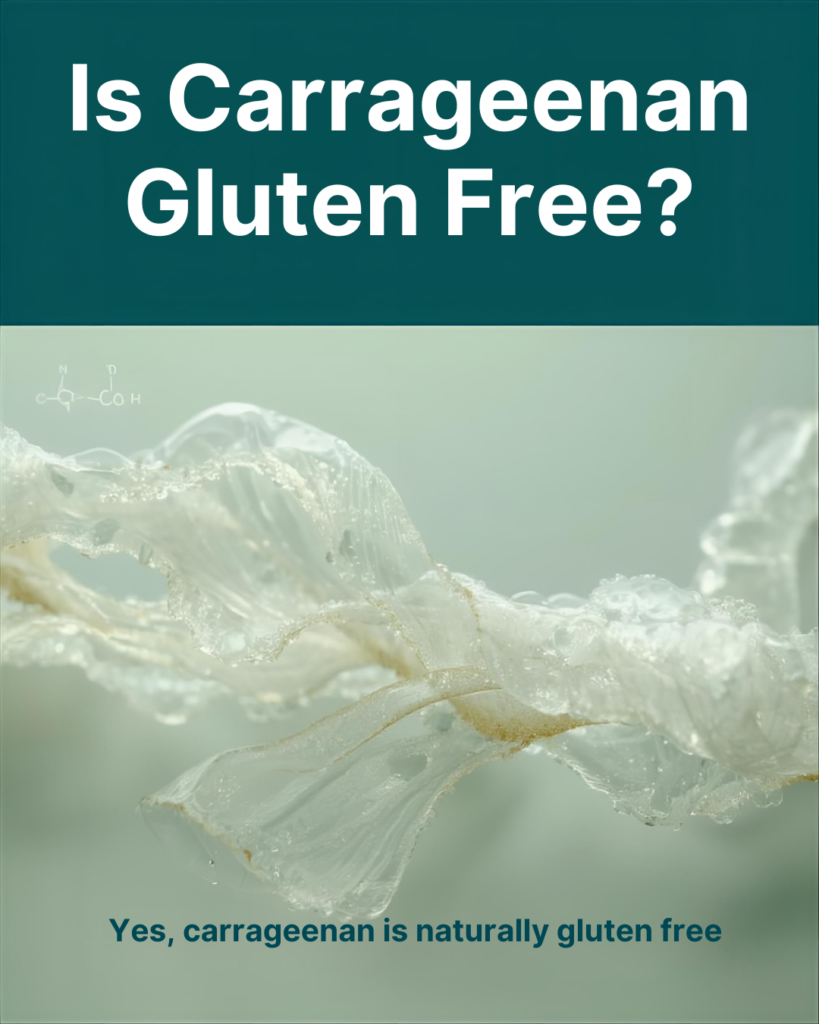
Yes, carrageenan is naturally gluten free.
Carrageenan does not contain gluten because it is derived entirely from seaweed, not from gluten-containing grains like wheat, barley, or rye.
Why Carrageenan Contains No Gluten
- Seaweed does not produce gluten proteins
- Carrageenan is a polysaccharide, not a grain-based ingredient
- It contains zero wheat-derived components
Is It Safe for Gluten-Sensitive Individuals?
Carrageenan is suitable for:
- People with celiac disease
- Individuals with gluten intolerance
- Products labeled as gluten-free, when manufactured correctly
The only concern is cross-contamination, which depends on manufacturing practices—not the ingredient itself.
How Carrageenan Is Made & Why It Contains No Gluten
Carrageenan production starts with harvesting red seaweed from clean coastal waters. The seaweed is then washed, dried, and processed to extract carrageenan using water-based methods.
Simplified Manufacturing Overview
- Seaweed harvesting
- Cleaning and drying
- Hot water extraction
- Filtration and purification
- Drying and milling
Because no grains or gluten-containing raw materials are involved at any stage, gluten cannot be introduced naturally during processing.
This is why working with a certified carrageenan supplier that follows food safety standards is essential. Manufacturers like Chemie Colloids focus on quality control and traceability to ensure ingredient purity.
FDA Approval & Global Safety Regulations
Carrageenan is one of the most widely studied food additives in the world.
Regulatory Status
- FDA (USA): Classified as GRAS (Generally Recognized as Safe)
- EFSA (Europe): Approved for food use
- JECFA (WHO/FAO): Evaluated and permitted within safety limits
Food-Grade vs Degraded Carrageenan
A key safety distinction:
- Food-grade carrageenan: Approved and safe for consumption
- Degraded carrageenan (poligeenan): Not approved for food use
Most health-related myths arise from confusion between these two. Regulatory bodies approve only food-grade carrageenan for consumption.
Common Myths About Carrageenan (Debunked)
Myth 1 – Carrageenan Contains Gluten
This is false. Carrageenan is seaweed-derived and contains no gluten proteins. The myth exists due to misunderstanding of ingredient sourcing.
Myth 2 – Carrageenan Is Artificial or Chemical
Carrageenan is natural, extracted from red seaweed. While it is processed for food use, it is not synthetic like many artificial additives.
Myth 3 – Carrageenan Is Always Bad for Health
Scientific evaluations consistently confirm that food-grade carrageenan is safe when consumed within approved limits. Context and quality matter.
Why Is Carrageenan Used in Gluten-Free Foods?
Gluten-free formulations often lack the structural properties gluten provides. Carrageenan helps bridge that gap.
Key Functional Benefits
- Improves texture and body
- Stabilizes liquids and emulsions
- Enhances mouthfeel
- Prevents separation
Common Gluten-Free Applications
- Ice cream
- Plant-based milk
- Protein shakes
- Dairy alternatives
Manufacturers rely on carrageenan to create products that feel familiar and enjoyable—even without gluten.
Foods That Commonly Contain Gluten-Free Carrageenan
You may find carrageenan in:
- Ice cream
- Chocolate milk
- Almond milk and oat milk
- Deli meats
- Sauces and dressings
These products use carrageenan to maintain consistency and shelf stability while remaining gluten free.
Carrageenan vs Other Gluten-Free Gelling Agents
| Ingredient | Source | Texture Control | Cost Efficiency |
| Carrageenan | Red seaweed | High | High |
| Agar | Seaweed | Very firm | Moderate |
| Locust Bean Gum | Seed-based | Thickening only | Higher |
Carrageenan is often preferred due to its versatility, performance, and cost-effectiveness across multiple food systems.
How to Choose a Safe, Gluten-Free Carrageenan Supplier
When selecting a carrageenan supplier, manufacturers should look for:
- Food-grade certification
- FDA and international compliance
- Strong traceability systems
- Consistent quality testing
Trusted hydrocolloid manufacturers like Chemie Colloids prioritize regulatory compliance and ingredient safety, making them reliable partners for gluten-free food production.
FAQ Section
Does carrageenan contain gluten?
No. Carrageenan is naturally gluten free.
Is carrageenan safe for celiac disease?
Yes, when food-grade and produced under certified conditions.
Is carrageenan FDA approved?
Yes. It is classified as GRAS by the FDA.
Why do gluten-free products use carrageenan?
To improve texture, stability, and mouthfeel.
Is carrageenan natural or synthetic?
Carrageenan is naturally derived from red seaweed.
Conclusion
Carrageenan is naturally gluten free, FDA-approved, and safe when used in its food-grade form. Most concerns surrounding carrageenan stem from misinformation or confusion with non-food-grade variants.
For consumers, reading labels and understanding ingredient sourcing helps make confident choices. For manufacturers, sourcing from reputable suppliers such as Chemie Colloids ensures safety, compliance, and consistent product quality.
Understanding the facts allows carrageenan to be appreciated for what it truly is—a functional, natural ingredient that supports modern gluten-free food innovation.